

iVEC

News

Archive for ‘Media Releases’

Official launch of fully operational ‘Magnus’ and Pawsey Supercomputing Centre rebranding


L-R: Pawsey Supercomputing Centre Executive Director Dr Neil Stringfellow, the Hon. Donna Faragher MLC, Pawsey Supercomputing Centre Chairman John Langoulant AO, Chief Scientist of Western Australia Professor Peter Klinken

L-R: Pawsey Supercomputing Centre Executive Director Dr Neil Stringfellow, the Hon. Donna Faragher MLC, Pawsey Supercomputing Centre Chairman John Langoulant AO, Chief Scientist of Western Australia Professor Peter Klinken


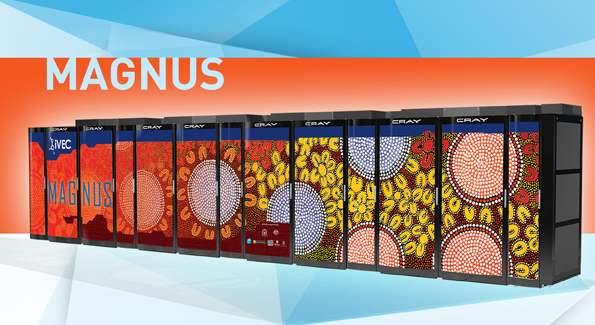
The Pawsey Supercomputing Centre is proud to announce the beginning of a new chapter in its operation and a significant leap forward in Western Australian science with the launch of the new Pawsey Supercomputing Centre brand and its fully operational Magnus supercomputer on Friday December 5.

The launch cements WA’s status as a global technological leader, with the state now having access to the most powerful supercomputer in the Southern Hemisphere, as well as the world-class resources and expertise provided by the Centre.

The Hon. Donna Faragher MLC, representing the Western Australian Government, launched both the newly upgraded Magnus and the announcement of iVEC rebranding as the Pawsey Supercomputing Centre.

Joining her was Chief Scientist of Western Australia Professor Peter Klinken, as well as Pawsey Supercomputing Centre Chairman John Langoulant AO.

Professor Klinken spoke of the pivotal role of supercomputing and in particular the Pawsey Supercomputing Centre for the advancement of Western Australia in the 21st century.

“This launch signifies not only the next step in the evolution of our organisation, but also for science in Western Australia,” says Pawsey Supercomputing Centre Executive Director Dr Neil Stringfellow.

“Scientists from across the State and the nation can now access the 41st most powerful supercomputer in the world, right here in Perth.

“Magnus and the Pawsey Supercomputing Centre will help power elite research across key scientific disciplines for WA, including radio astronomy, geoscience, medicine and bioinformatics.”

As well as the launch of the fully operational Magnus, the event also saw the beginning of the rebranding of iVEC into the Pawsey Supercomputing Centre.

After fourteen years of successful operation as iVEC, the organisation has decided to align itself with the Pawsey Supercomputing Centre name.

“By rebranding to the Pawsey Supercomputing Centre, we are able to make the most of the potential of this world-class facility,” says Dr Stringfellow.

“Today’s launch of the Pawsey Supercomputing Centre name, and the world-ranking Magnus supercomputer is just the beginning for our organisation and for Western Australian science.”

For more information, contact David Satterthwaite, Marketing and Communications Manager at [email protected] or 08 6436 8959.
Magnus debuts at #41 on global Top 500 list


MagnusPawsey2

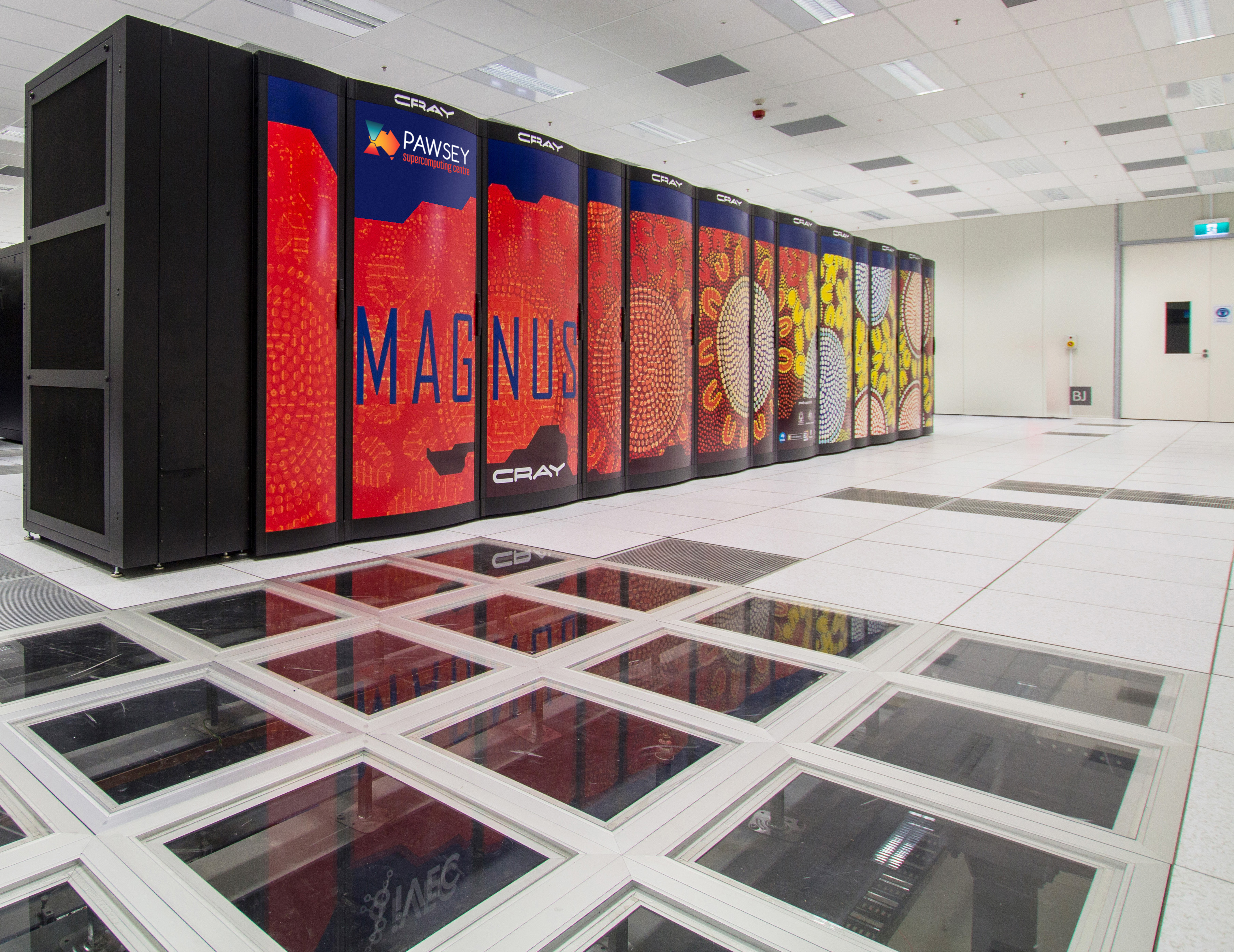
Magnus at the Pawsey Supercomputing Centre

The Pawsey Supercomputing Centre is proud to announce its recently upgraded “Magnus” petascale supercomputer has debuted at #41 on the latest global Top500 supercomputing list, announced today at SC14 in New Orleans.

Achieving 1,097 TeraFLOPS (floating point operations per second) on the Linpack benchmark run, this makes Magnus currently the most powerful scientific supercomputer in the Southern Hemisphere.

Magnus, from the Latin for “Great”, is a latest generation Cray XC40 system using state-of-the-art Intel Xeon E5-2690V3 “Haswell” processors running at 2.6GHz, for a total of 35,712 cores.

The system empowers cutting-edge research through high-end supercomputing projects across the entire range of scientific fields supported by the Pawsey Supercomputing Centre.

“With the debut of Magnus within the world’s top 50 most advanced supercomputers, Australian researchers now have access to true world-class supercomputing capabilities,” says Pawsey Supercomputing Centre Executive Director Dr Neil Stringfellow.

“We are excited to see what groundbreaking research results can be achieved using Magnus.”

The Pawsey Supercomputing Centre recently awarded almost 90 million CPU hours on Magnus as part of its Petascale Pioneers Program.

The program encompasses 17 elite projects from national and international researchers, chosen for grand-challenge scientific problems able to take full advantage of the capabilities of the newly upgraded Magnus.

The Petascale Pioneers Program will showcase the previously unimaginable possibilities that Magnus opens up to Australian researchers.

The Pawsey Supercomputing Centre looks forward to welcoming researchers from across Australia to make use of its resources for years to come.

For more information, please contact David Satterthwaite, Marketing & Communications Manager at [email protected] or 08 6436 8959.
Petascale Pioneers put Pawsey Supercomputing Centre to the test


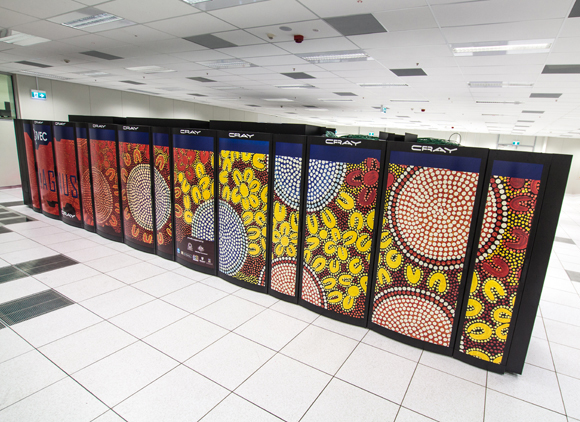
The newly upgraded petascale 'Magnus' at the Pawsey Supercomputing Centre.

The newly upgraded petascale ‘Magnus’ at the Pawsey Supercomputing Centre.

The Pawsey Supercomputing Centre’s Petascale Pioneers program is bringing the world’s best researchers to Australia, using ‘Magnus’, the most advanced scientific supercomputer in the Southern Hemisphere.

The Centre has awarded almost 90 million CPU-hours for pioneering research projects to use the petascale supercomputer Magnus from September to December 2014.

These projects are able to take advantage of the world-class capabilities of Magnus, an eight-cabinet Cray XC40 machine with over 35,000 cores using Intel Xeon E5-2600 v3 processors and 95 TB of memory.

In September, the Pawsey Supercomputing Centre installed the final stage upgrade for Magnus, ushering in a new era of Australian research.

The upgrade saw Magnus break the PetaFLOP (one quadrillion floating point operations per second) barrier.

In one second, Magnus is able to perform more calculations than the entire population of Australia could in 21 years.

The installation of this world-class technology meant demand for the program was exceptionally high.

“We had nearly three times the requests for time than what we could accommodate,” says supercomputing specialist Rebecca Hartman-Baker, who coordinated the call for proposals.

The projects chosen under the program span priority areas of research from geoscience to astrophysics, chemistry and bioinformatics.

These elite research projects, dubbed Petascale Pioneers, were accepted based on their ability to take advantage of the state-of-the-art technologies provided by the Pawsey Supercomputing Centre and Magnus.

In particular, projects were chosen for grand-challenge scientific problems that would be impossible without the immense processing power of petascale supercomputing.

Fourteen projects were selected as petascale pioneers, and three additional projects that were more experimental in nature were added as pioneering director’s share projects.

The projects are led by teams of Australian, international and Western Australian researchers.

Three quarters of the WA researchers in the program are collaborating internationally.

“Australian researchers now have to access a world-class supercomputer right here in Perth,” says Pawsey Supercomputing Centre Executive Director Dr Neil Stringfellow.

“In addition, we are pleased to enable collaborative research projects between local and international researchers.”

For more information, please contact David Satterthwaite on [email protected] or 08 6436 8959.
iVEC supports Big Data Week 2014


banner_feature_600x300-1

iVEC’s Data Team will support the global Big Data Week (BDW) for the second year running.

Big Data Week is a unique global platform of interconnected crowd sourced events focusing on the social, political, technological and commercial impacts of Big Data.

Perth is the only Australian city taking part in the global Big Data Week 2014, and iVEC is proud to play an integral role.

Correspondingly iVEC with collaborators has planned a week-long programme of events (11 in total) that include presentations, networking opportunities and activities which will look at some of the challenges and opportunities presented by the growth of Big Data.

As part of Big Data Week 2014 in Perth, there will be a ‘Perth Data Challenge’ that will run from the 10th April to the end of Big Data Week 9th May 2014.

For more details and information, please visit the Big Data Week Perth website or contact Dave Satterthwaite on [email protected] or 08 6436 8959.
Pawsey Supercomputing Centre second stage details released


iVEC's Magnus supercomputer will be upgraded as part of the second stage of the Pawsey Centre

iVEC’s Magnus supercomputer will be upgraded as part of the second stage of the Pawsey Centre

iVEC is pleased to announce the final details of the second stage of the Pawsey Supercomputing Centre hardware that will be installed later this year.

The second stage upgrade will see the Pawsey Centre become a petascale supercomputing facility, with the supercomputer ‘Magnus’, a Cray® XC40™, delivering processing power in excess of a petaflop (one quadrillion floating point operations per second).

‘Magnus’, a Cray® XC40™ supercomputer, will provide users with over 35,000 cores, using the future Intel® Xeon® processor E5-2600 v3 product family (former codename Haswell), and is expected to be the most powerful supercomputer in the southern hemisphere.

This greatly enhances the future Australian research outcomes iVEC will deliver.

The Pawsey Supercomputing Centre has been operating since November 2013 and the upgrade marks the beginning of a new era in Western Australian science.

The Centre’s two Cray® XC40™ supercomputers, Magnus and Galaxy, are already delivering practical research outcomes across the full range of scientific disciplines, with a focus on radio astronomy and geosciences.

Scientists using the new second stage resources at the Pawsey Supercomputing Centre will be able to achieve world-class research outcomes and break new ground in a range of cutting edge areas of research.

The upgrade is the next step in iVEC’s continuing dedication to providing the best possible resources and infrastructure for local and national researchers.

The Pawsey Supercomputing Centre is an initiative of the Australian Government being conducted as part of the Super Science Initiative and financed from the Education Investment Fund.

For more information, please contact David Satterthwaite on [email protected] or 08 6436 8959.

iVEC’s Paul Bourke at the Lawrence Wilson Art Gallery p a n o r a m a exhibition


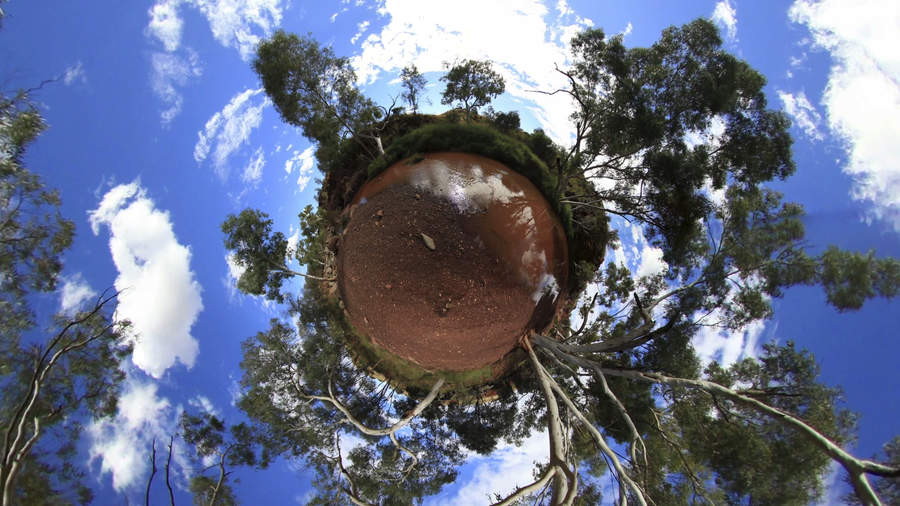
Stills from Paul Bourke's Little Planet animation sequence at p a n o r a m a

A still from Paul Bourke’s Little Planet animation sequence at p a n o r a m a

Several pieces of artwork by iVEC’s Head of the Visualisation Team and iVEC@UWA facility leader, Associate Professor Paul Bourke, are being displayed at the Lawrence Wilson Gallery as part of the p a n o r a m a exhibition.

The exhibition is an exploration of how panoramas have been used in historical and contemporary contexts for diverse scientific, artistic and documentary purposes.

Assoc. Professor Bourke’s contributions to the exhibition include a three metre, 360 x 180 degree panorama of of a rock art site at Wanmanna, produced in 2012 in collaboration with Jo McDonald from the Centre for Rock Art Research and Management.

Other work produced at Beacon Island in 2013 in collaboration with the WA Museum and Maritime Archeology at UWA provides an extraordinary visual record of an important site in Australia’s history, facilitating research into the earliest landfall by Europeans.

p a n o r a m a held its opening night on Friday 2 May, and is on exhibit at the Lawrence Wilson Art Gallery until 12 July 2014.

iVEC is a proud campus partner for the p a n o r a m a exhibition.

For more information contact David Satterthwaite on [email protected] or 08 6436 8959.

iVEC NeCTAR Cloud moving towards operational phase


rsz_1nectar_logo_v2

iVEC is pleased to announce that its joint proposal to establish a NeCTAR Research Cloud node is moving towards an operational phase.

It is expected that by October 2014, the iVEC contribution to the national research cloud (predicted to be more than 30,000 cores) will be operational.

In the next few months iVEC will make a national call for early adopters who may require support to scale up to using Cloud services.

Further details of Cloud services are available from Jenni Harrison, iVEC’s Head of Data on: [email protected] on [email protected] or 08 6488 7153.

Project CATAMI now fully operational


iVEC is pleased to report that NeCTAR-funded Project CATAMI is now complete, with all tools fully operational.

Project CATAMI provides an online data management and image annotation system for marine ecologists, with a twist. Specifically, features include:

• Transect data management and visualisation.
• Fine- and broad-scale still image annotation.
• Similar image recognition for a faster annotation process.

These tools allow researchers to share projects with colleagues and collaborators.

More details are available from the CATAMI website.

Project CATAMI has also recently been nominated for a prestigious WA Information Technology and Telecommunications Award (WAiTTA).

The purpose of WAiTTA is to recognise outstanding performance and contributions by members of the ICT community in Western Australia.

More information on WAiTTA is available from the WAiTTA website.

For further information, please contact Jenni Harrison on [email protected] or 08 6436 8959.

Page 1 of 3 123