



The Pawsey Centre was designed to use traditional water cooling towers as a reliable and cheap way to cool the supercomputers and other ICT equipment. Two additional cooling technologies are also being developed at the Pawsey Centre to reduce its environmental impact. These fall under the Sustainable Energy for the Square Kilometre Array (SESKA) geothermal project, which is also managed by CSIRO using funding from the Education Investment Fund. A total of $21.8M has been funded for the ARRC/Pawsey sub-project. (A further $45.4M has been funded for a sub-project at the Murchison Radio-astronomy Observatory).
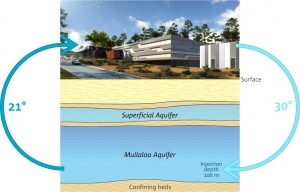 The process involves pumping water with an ambient temperature of around 21°C from the Mullaloo aquifer through an above-ground heat exchanger to provide the necessary cooling effect for the supercomputer, then reinjecting the water back into the aquifer. CSIRO estimates that using groundwater cooling to cool the supercomputer will save approximately 38.5 million litres of water every year, compared with using conventional cooling towers.
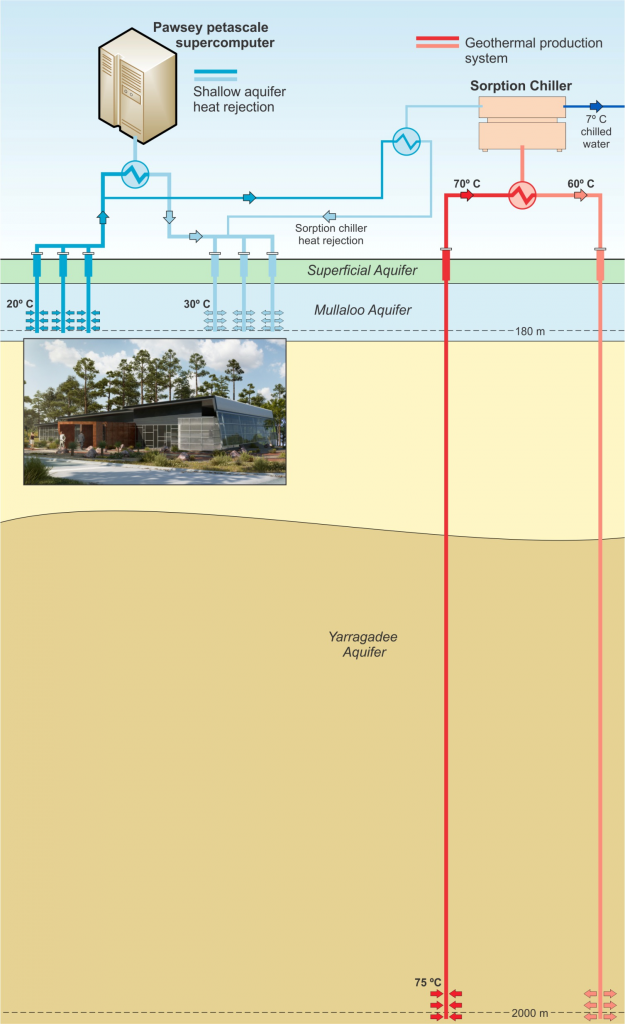 As well as developing groundwater cooling, the CSIRO Geothermal Project also involves drilling 3km below ground to assess the geothermal resource beneath the ARRC site, and its potential use for cooling applications. The resource is a hot aquifer that has the potential to drive an absorption chilling system. The cooled water from the aquifer would be pumped back into the deep aquifer to close the loop. The heat from the system is rejected into the upper aquifer.
See the CSIRO website for further information on these projects.
