Project leader Dr. Jungho Park
CSIRO Land and Water
The oil industry is seeking new methods of increasing oil production from geological reservoirs. This project studies the fundamental fluid processes underpinning enhanced oil recovery with a view to designing innovative engineering technologies for boosting oil industry performance.
This supercomputer simulation shows a residual oil phase (red) being displaced by water (blue) in a heterogeneous oil reservoir during water injection. The shapes of the residual oil phase globules are related to the permeability structure and wetting characteristics of the reservoir but the relationship is complex. Advanced computational techniques must be used to simulate the oil-water dynamics in detail and to explore efficient new engineering mechanisms to reduce the amount of residual oil trapped in the reservoir. By using the power of the Pawsey Centre’s supercomputers, these techniques can be continually refined, leading to solutions that reduce residual oil volume and therefore allow greater oil production from reservoirs and increased industry productivity.
Image credit: Dr Jungho Park,
CSIRO Land and Water

Project leader Prof. Ben Mullins
Curtin University
Aerosol science plays an important role in the health sector and iVEC’s supercomputing resources are being used in a project to examine the comparative effectiveness of liquid and powder medications in penetrating the airways. The aim of this research is to provide predictions of outcomes for invasive lung surgery, optimise aerosol drug delivery and study the deposition of air pollutants in the lungs.
To accurately study the effectiveness of the medications, a 3D model set of lungs has been created. This model simulates expanding and contracting lungs, with a level of realism beyond that experienced by any other research group.
This model involves highly complex Computational Fluid Dynamic (CFD) simulations which require the power of supercomputing to develop. Both the particle code and the moving mesh algorithm used in the model are highly computationally intensive to resolve, and require a huge data transfer between computer cores in order to reach a solution in a reasonable time.
Without iVEC’s wide range of resources, this research would not have been possible to achieve practically using traditional methods. The image shows a high resolution simulation performed on the Magnus supercomputer of airflow and expansion (breathing) of a lung.
The lung geometry used for the simulation is obtained from a 3D, computed tomography (CT) scan.
Main contributors to this project are Curtin University’s Dr Andrew King and Dr Ryan Mead-Hunter.

Molecular modelling of the adsorption of magnesium
Project leader Dr. Paolo Raiteri
Curtin University
Carbonates are ubiquitous materials that are present in our everyday life in the form of scale and sea shells. Calcium carbonate is particularly important for the survival of marine species that are capable of extracting calcium and carbonate ions from sea water to produce their exoskeletons. In the oceans, magnesium is much more abundant than calcium but it is not used by living organisms. However, there is growing experimental evidence that in certain conditions the presence of magnesium promotes the growth of specific forms of calcium carbonate. This project uses the power of iVEC’s supercomputers to run molecular dynamics simulations to study the effects of the adsorption of magnesium on the surface of a growing piece of calcium carbonate, examining whether or not it is incorporated and how it modifies the mineral growth over time.
The image shows adsorption of magnesium on calcium carbonate immersed in water. The magnesium ion is represented as a brown sphere while the oxygen and hydrogen atoms of water are represented as red and white spheres. Calcium atoms are coloured in green and the carbonate is composed of a carbon atom (cyan) and three oxygen atoms (red) surrounded by a transparent sphere.

CSIRO project
CSIRO’s newest radio telescope, the Australian SKA Pathfinder, is a next generation facility with novel receiver technologies and leading-edge ICT systems. This high speed survey instrument is made up of 36 identical antennas that will work together as a single instrument.
The wide field-of-view and high survey speed that ASKAP offers will allow astronomers to answer fundamental questions about the creation and early evolution of our Universe, and to test theories of cosmic magnetism and predictions from Einstein’s theory of general relativity.
ASKAP will generate enormous data rates (equivalent to 1 DVD every 2 seconds) that require data processing and archiving to be performed synchronously with observations.
As a fundamentally ‘real-time’ telescope, the software systems produce data products for astronomers. Processing and storing data products will occur right here at iVEC’s Pawsey Centre, using the supercomputing and storage facilities.
In the image: Antennas of CSIRO’s Australian SKA Pathfinder (ASKAP) telescope, at the Murchison Radio-astronomy Observatory (MRO) in Western Australia. Credit: Alex Cherney/terrastro.com

Project leader Prof. Steven Tingay
Curtin University
The Murchison Widefield Array (MWA) is the low frequency precursor for the Square Kilometre Array (SKA), located at the Murchison Radioastronomy Observatory (MRO). MWA data are processed at the MRO, transported over an 800km optical fibre network, archived at the Pawsey Centre, and made available to scientists around the world.
The MWA is the first of the three SKA precursor telescopes to be made operational for science since August 2013. As such, the MWA project is the first “Big Data” user of the Pawsey Centre, producing data at a rate of 3 petabytes per year. These data serve a world-wide team of radio astronomers, working on nine large-scale projects, which have been assessed and approved by an independent international panel. The bottom part of the image shows the MWA site at night, with a tile holding 16 antenna elements over a 5×5-metre ground screen, with the beamformer at the far edge of the tile. The top of the image is an MWA image of the Milky Way galaxy, spanning a large fraction of the southern sky.
The MWA consortium consists of thirteen institutions from four countries, and is led by Curtin University.

Project leader Shuo Wang
CSIRO
With bread one of humanity’s universal staples, iVEC’s supercomputing resources are being used to find out how the highest quality bread is created, by analysing its structure.
Using microCT imaging and computational modelling techniques commonly used in analysing minerals, the researchers aim to characterise the internal structure of types of bread to isolate what contributes to the best taste and consistency. This data is used to create detailed 3D models, an example of which can be seen at the top of the image, representing a 2D view of what is in reality a 3-dimensional cube that can be analysed in detail by researchers.
This kind of modelling is highly computationally-intensive, with iVEC’s supercomputing resources allowing it to be conducted smoothly and in a reasonable time frame.
The foam structure within bread has not been accurately characterised previously and this is a major step forward in cereal science. Objective high resolution descriptions of bread quality have the potential to replace outdated subjective measures, assisting in enhancing export market perceptions of Australian wheat, with the flow-on potential of adding significant value for Australian wheat growers.
Curtin University project leader Dr. Andrew King
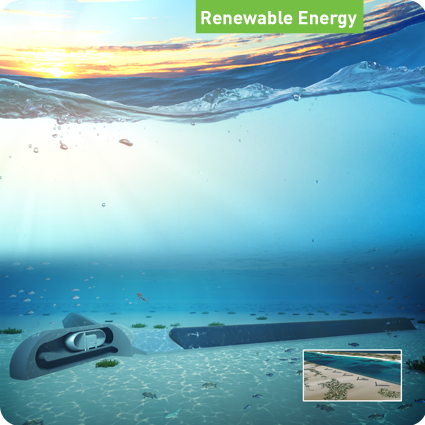
The Bombora wave power system is an innovative system that efficiently converts the ocean’s wave energy directly into electricity more effectively and reliably than current alternatives.
Located near to shore and fully submerged on the seabed, the system utilises a large, low cost membrane energy harvester to collect, concentrate and modulate the wave energy through the use of an air circuit. The system has an onboard 1.5MWe rated air turbine generator located within the apex of its Vee-shaped structure. As a wave passes over the system it moves air around the circuit and drives it through the turbine, which in turn spins a generator, creating electricity. This electricity is then delivered onshore via an electrical cable and connected to the distribution network.
iVEC’s supercomputing resources are used to run highly advanced Computational Fluid Dynamic simulations to predict the pressures acting on the membrane, and effects on the wave field. Through the power of supercomputing the output of the device is now able to be predicted accurately and efficiently.

Project leader Dr Andrew Hutchison
Curtin University
Utilising iVEC’s resources and expertise, the Sydney-Kormoran Project is developing image capture and visualisation techniques that will conserve and interpret the WWII shipwreck sites of HMAS Sydney II and HSK Kormoran for future generations. The two ships sank each other in one of the most unusual naval battles in history, and the sinking of HMAS Sydney was the worst loss of life to ever occur to the Royal Australian Navy.
In 2014, remotely operated submersibles will be used to image the wrecks in extreme detail. This data will be collected and collated, with advanced visualisation tools used to display it in an accessible and attractive format. By 2016, a virtual sub-sea exhibition in WA and in Sydney, at the Australian National Maritime Museum, will allow hundreds of thousands of visitors to experience this important story first hand.
This project is a joint effort by Curtin University, The University of Western Australia, the WA Museum, and subsea industry partners, to preserve a unique part of Australia’s naval history.