iVEC

News

Archive for ‘News’

Position available: Computing Cloud Specialist


Computing Cloud Specialist

Work type: full-time

Location: Crawley, iVEC@UWA (Pawsey Supercomputing Centre)
Categories: Information Technology

Tenure: Appointment up to March 2016
Salary range: Level 8 $88,988 – $97,460 p.a.

This is an exciting opportunity, working with world class infrastructure, to lead the management of NeCTAR Funded Cloud Outreach Services within The Pawsey Supercomputing Centre. This challenging role will require a Cloud Computing Specialist with experience of working across multiple research institutions and environments to routinely engage with researchers. We are seeking a team player with energy, vision and the ability to communicate with multiple stakeholders at various levels. How to apply: Read the job description and download the position documentation found on the UWA website.

Contact: Jenni Harrison after accessing the position documentation found on the UWA website (PDF).

Closing date: W. Australia Standard Time

Open call for poster submissions – HPC in Asia workshop at ISC’15


The Pawsey Supercomputing Centre would like to inform you that poster submissions are currently open for the HPC in Asia workshop at ISC’15, being held in Frankfurt Germany from July 12-16.

Following a successful debut in 2014, this will be the second year Australia is a part of the workshop, with the Pawsey Supercomputing Centre as the Australian representative for the HPC in Asia consortium.

The poster session is a great opportunity for young researchers and graduate students in the computational science field to promote their research results and engage with peers from across Asia, North America and Europe.

The Pawsey Supercomputing Centre encourages those interested to submit their posters before the deadline on February 15.

Successful posters will be displayed alongside the research posters from July 13 – 15, as well as during the dedicated HPC in Asia poster session on July 15.

For more details on the poster session and requirements for submission, please click here.

ISC’15 marks the 30th year of the ISC High Performance conference series, and will see a diverse range of presentations, poster sessions, workshops and tutorials on the latest developments in HPC.

The conference will be held in Frankfurt Germany from July 12-16.

For more information about ISC’15, please visit the event website.

Pawsey Supercomputing Centre rebranding update


PawseyLogoHorizontal1000px

Friday, December 5 saw the Hon Donna Faragher MLC announce the beginning of the rebranding of iVEC to the Pawsey Supercomputing Centre in tandem with launching the final stage of the ‘Magnus’ supercomputer.

The retiring of the iVEC brand in favour of the Pawsey Supercomputing Centre is a decision made to leverage the high profile of the Centre with many of our stakeholders and allow us to focus our efforts around its capacity to deliver services locally, nationally and internationally.

At this point, only the name of the organisation has changed. The rebranding is a phased process, which will continue into early 2015. We provide a diverse range of services across different platforms, so the rebranding will be conducted carefully in order to ensure it does not impinge on your access to these resources.

As a result, your access points for our range of services will not be changing at this time. Access should still be conducted through the iVEC portals, Help Desk, and the main iVEC website at www.ivec.org.

As changes to our internal and external services approach, we will notify you considerably in advance so that you are able to react accordingly. We aim to make this process as smooth as possible so will be gradually phasing things in with the minimum disruption.

If you wish to contact iVEC staff, this can still be done through the existing iVEC email addresses.

If you have any questions about the rebranding process, please feel free to email

Cortex (PB Store) Removal from Service – 31 March 2015


PBStoreremovalbanner


Cortex (also known as PB Store) will be removed from service on 31 March 2015.

All data held on Cortex will be inaccessible beyond this time, by any methods and with no exceptions.

If you still require any data being held on Cortex, please move this data to another location as soon as possible.

Please note, Cortex traffic in 2015 is expected to rise sharply and all data transfers will be slower than normal. Therefore, please plan your data migration appropriately and expect to move your data as soon as possible.

If you require additional storage, and your project can meet the terms and conditions for storage as described on the iVEC website, please use the online application form available here.

If you need further information or help, please contact

Official launch of fully operational ‘Magnus’ and Pawsey Supercomputing Centre rebranding


L-R: Pawsey Supercomputing Centre Executive Director Dr Neil Stringfellow, the Hon. Donna Faragher MLC, Pawsey Supercomputing Centre Chairman John Langoulant AO, Chief Scientist of Western Australia Professor Peter Klinken


The Pawsey Supercomputing Centre is proud to announce the beginning of a new chapter in its operation and a significant leap forward in Western Australian science with the launch of the new Pawsey Supercomputing Centre brand and its fully operational Magnus supercomputer on Friday December 5.

The launch cements WA’s status as a global technological leader, with the state now having access to the most powerful supercomputer in the Southern Hemisphere, as well as the world-class resources and expertise provided by the Centre.

The Hon. Donna Faragher MLC, representing the Western Australian Government, launched both the newly upgraded Magnus and the announcement of iVEC rebranding as the Pawsey Supercomputing Centre.

Joining her was Chief Scientist of Western Australia Professor Peter Klinken, as well as Pawsey Supercomputing Centre Chairman John Langoulant AO.

Professor Klinken spoke of the pivotal role of supercomputing and in particular the Pawsey Supercomputing Centre for the advancement of Western Australia in the 21st century.

“This launch signifies not only the next step in the evolution of our organisation, but also for science in Western Australia,” says Pawsey Supercomputing Centre Executive Director Dr Neil Stringfellow.

“Scientists from across the State and the nation can now access the 41st most powerful supercomputer in the world, right here in Perth.

“Magnus and the Pawsey Supercomputing Centre will help power elite research across key scientific disciplines for WA, including radio astronomy, geoscience, medicine and bioinformatics.”

As well as the launch of the fully operational Magnus, the event also saw the beginning of the rebranding of iVEC into the Pawsey Supercomputing Centre.

After fourteen years of successful operation as iVEC, the organisation has decided to align itself with the Pawsey Supercomputing Centre name.

“By rebranding to the Pawsey Supercomputing Centre, we are able to make the most of the potential of this world-class facility,” says Dr Stringfellow.

“Today’s launch of the Pawsey Supercomputing Centre name, and the world-ranking Magnus supercomputer is just the beginning for our organisation and for Western Australian science.”

For more information, contact David Satterthwaite, Marketing and Communications Manager.

Magnus debuts at #41 on global Top 500 list


The Pawsey Supercomputing Centre is proud to announce its recently upgraded “Magnus” petascale supercomputer has debuted at #41 on the latest global Top500 supercomputing list, announced today at SC14 in New Orleans.

Achieving 1,097 TeraFLOPS (floating point operations per second) on the Linpack benchmark run, this makes Magnus currently the most powerful scientific supercomputer in the Southern Hemisphere.

Magnus, from the Latin for “Great”, is a latest generation Cray XC40 system using state-of-the-art Intel Xeon E5-2690V3 “Haswell” processors running at 2.6GHz, for a total of 35,712 cores.

The system empowers cutting-edge research through high-end supercomputing projects across the entire range of scientific fields supported by the Pawsey Supercomputing Centre.

“With the debut of Magnus within the world’s top 50 most advanced supercomputers, Australian researchers now have access to true world-class supercomputing capabilities,” says Pawsey Supercomputing Centre Executive Director Dr Neil Stringfellow.

“We are excited to see what groundbreaking research results can be achieved using Magnus.”

The Pawsey Supercomputing Centre recently awarded almost 90 million CPU hours on Magnus as part of its Petascale Pioneers Program.

The program encompasses 17 elite projects from national and international researchers, chosen for grand-challenge scientific problems able to take full advantage of the capabilities of the newly upgraded Magnus.

The Petascale Pioneers Program will showcase the previously unimaginable possibilities that Magnus opens up to Australian researchers.

The Pawsey Supercomputing Centre looks forward to welcoming researchers from across Australia to make use of its resources for years to come.

For more information, please contact David Satterthwaite, Marketing & Communications Manager.

Bioinformatics Petascale Pioneers Program


Bioinformaticspioneers


The Pawsey Supercomputing Centre seeks expressions of interest for pioneering projects in the field of bioinformatics to use the Pawsey resource Galaxy during the first six months of 2015. This follows on from the highly successful original Petascale Pioneers Program, and has been prompted in part by the overwhelming positive response to the Pawsey Petascale Bioinformatics Symposium.

Galaxy is a Cray XC30 supercomputer containing 134 compute blades, each of which has four nodes. The majority of the nodes (484) support two ten-core Intel Xeon E5-2690v2 ‘Ivy Bridge’ processors with 64 GB of memory, for a total of 9,440 cores delivering roughly 220 TFLOPS (peak) computing power. The remaining 64 nodes consist of a single Intel Xeon E5-2670 ‘Sandy Bridge’ host processor with 32 GB of memory plus an NVIDIA K20X ‘Kepler’ GPU accelerator with 6 GB memory, delivering an additional 90 TFLOPS (peak) computing power. The machine interconnect is Cray’s high-speed, low-latency Aries interconnect in the Dragonfly topology, and the machine is attached to a Cray Sonexion 1600 appliance with 1.3 PB of scratch storage space.

We anticipate awarding on the order of six projects a share of 12 million CPU-hours and Pawsey Supercomputing Team expertise to assist in transitioning to the supercomputing environment. In addition to helping to port codes to the unique Cray environment, we will provide each project with help in scaling team-developed codes or transitioning to new applications more suitable to the high-performance computing environment. In addition, near the beginning of the six-month period we will host a week-long mentorship session in Perth for all projects selected, with Pawsey staff and national and international experts assisting the project teams. For interstate teams, limited matching travel grants will be available.

To register your interest, please submit a short description of your project (questions may also be sent to this address). The submission must include the following:

  • Name, address, affiliation, contact information
  • Project title
  • Project team
  • Project science description
    • A description of the science problem your project is trying to address
    • A description of how your project would benefit from the unique resources available in a supercomputing environment (as opposed to a workstation or desktop computer)
  • Project code descriptions, programming environment, and support
    • What code(s) do you plan to use? Describe your planned workflow.
    • What libraries/software does your project require?
    • How do you plan to accommodate for the walltime limits on Galaxy (expected to be 24 hours)? (e.g., checkpointing, running on larger processor counts to reduce walltime, etc.)
    • What storage does your project require? (scratch, short-term, long-term)
    • What support would you need from Pawsey in order for the project to be successful?
  • Project outcomes
    • Desired science outcomes
    • Other anticipated outcomes (e.g., verification that workflow incorporating new code will work for your science; submitting a partner scheme allocation request)

This opportunity is available to researchers from iVEC partner institutions and those employed in other Australian universities and research institutions. PhD students may not apply as the principal investigator, however they might wish to discuss this opportunity with their supervisors who could in turn submit a proposal as principal investigator.

The deadline for expressions of interest is 5pm Western Australian Standard Time on Friday 12th December 2014 and we expect to announce the successful projects shortly thereafter.

Pawsey Petascale Bioinformatics Symposium 2014


bioinformatics14-1-14


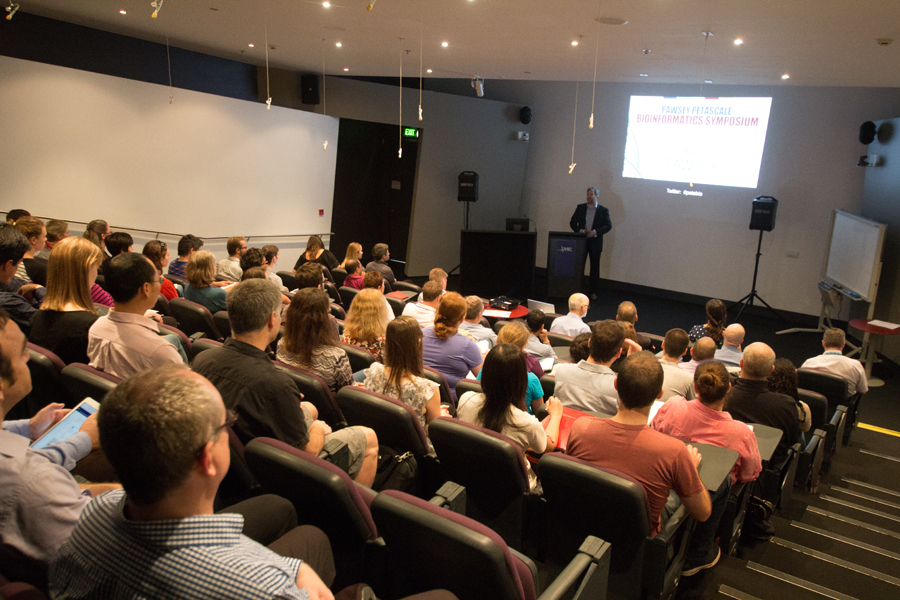
Last week saw the inaugural Pawsey Petascale Bioinformatics Symposium take place at the ARRC Auditorium in Kensington. Spread over two days from 10-11 November, the Symposium gathered together almost 100 leading local Western Australian researchers in bioinformatics for a series of keynote presentations from local and international experts, poster sessions and breakout discussions.

After a late venue change due to overwhelming demand, the Symposium began in earnest with a welcome from the Pawsey Supercomputing Centre’s Executive Director Dr Neil Stringfellow and Supercomputing Specialist Dr Rebecca Hartman-Baker, who also helped to organise the Symposium.

Keynote speeches were given by Andre J. Aberer from the Heidelberg Institute for Theoretical Studies (‘Big Computers for Big Trees: Challenges of Petascale Bioinformatics’) as well as over 20 local leading bioinformatics researchers from ten institutions.

bioinformatics14-1-2

“The diversity of WA organisations and impressive research represented at the Symposium was really inspiring,” says The University of Western Australia’s School of Chemistry and Biochemistry and ARC Centre of Excellence in Plant Energy Biology’s Dr Laura Boykin.

The Symposium also helped the Pawsey Supercomputing Centre to engage with this rapidly evolving research field, and discuss with researchers ways in which the Centre could help to better enable research on the petascale level.

“The Pawsey Supercomputing Centre’s willingness to embrace the bioinformatics field has really helped us to move forward as a community,” says Dr Boykin.

The Symposium also saw the Pawsey Supercomputing Centre announce the availability of 12 million CPU hours dedicated to bioinformatics research on its world-class real time supercomputer “Galaxy”.

On the final day of the Symposium, breakout discussion sessions were held to enable active and engaging brainstorming among attendees.

These discussion sessions helped see the creation of the Bioinformatics User Group (BUG) – a tightknit local community comprising Western Australia’s leading bioinformatics researchers from a diverse range of institutions.

The Pawsey Supercomputing Centre would like to thank all of the guests, speakers and attendees for their part in making the Symposium a success.

Page 1 of 14 12345»